HAZOP Guide words are one of the unique things about the Hazard and Operability technique. There are a set of commonly used words that can be used to generate multiple abnormal scenarios, which we call as "deviations" in the technique. Every such word coupled with a particular parameter, then represents a unique deviation. For example to study a deviation of a flow lesser than normal, we use the guideword less or lesser than, coupled with a parameter flow. These two combined give us the deviated scenario of less than normal flow.
This less than normal flow is then analyzed thoroghly by the HAZOP team members to brainstorm if it will lead to nay dangerous consequences. If such is indeed the case, then the team's scribe (also known as HAZOP Scribe) writes down this as a dangerous consequence in the worksheet. Generally if the plant's design is sufficiently robust, then such deviated conditions are taken care of by the basic process design such as for example, having a flow switch that trips the pumping if the flow is low (just an example). If not, then the team suggests this, which goes into the worksheet as a recommendation. There may be of course other ways in which these parameters can be recognized and safeguards built, to correct for the effects of such abnormal conditions happening.
But then we are deviating from the topic- we are here to learn about guide words, right? You may be wondering how can somebody think of all the guidewords that are needed? Well, you can simply write down all of them at the beginning itself, or enter them into your HAZOP Worksheet before you begin the study. If you are using a documenting HAZOP Software, then the guidewords are already in the database and will be used to generate the different scenario conditions.
What are some common examples of such guide words? Here is a snippet of such a list below:
LESS
MORE
OTHER THAN
REVERSE
NO
EARLY
LATE
Now if you couple them with a parameter such as FLOW, you get the deviations as below:
LESS FLOW
MORE FLOW
OTHER THAN FLOW (checks if the fluid has been substituted by another one)
REVERSE FLOW (direction of flow has changed)
NO FLOW (empty)
The below ones can be used for batch processes, where sequencing is of importance.
EARLY FLOW (fluid starts flowing earlier than what is designed)
LATE FLOW (starts flowing later than designed).
If you need a more comprehensive training in this technique, then simply go to the HAZOP training course here. You can get access to an excellent e-learning course and what's more, also earn a certificate and an electronic badge, if you pass the associated exam.
Thursday, May 2, 2019
Monday, December 25, 2017
Is HAZOP mandated by law? Where can I learn about it?
Hazard and Operability Study (HAZOP for short) is a highly popular Risk Assessment method that is the de-facto primary way of studying the amount of risk in any process industry operation. By process industry we mean Oil & Gas, Power Generation, Mining and similar sectors. In this method, we break down the process units into smaller sections called nodes and every such node is studied in depth with respect to what can go wrong and if it does then what? These are known as deviations.
The short video below gives an idea of the process.
All this is known, but the question that is asked by many is whether there is any legal basis for carrying HAZOP? Well, the answer is Yes and No. If you are looking for some Bill passed in Congress or some Act of Parliament in some country that says you must do a HAZOP, then no. There is to the best of my knowledge, no such law. BUT many of the legal acts in various countries and other rules and regulations have some references. For example in the US, following OSHA guidelines is mandatory by law and their 14 elements of Process Safety Management (PSM) do include Risk Assessment of the process, where HAZOP is specifically mentioned.
So while there is no direct law that says that you must do it, there are many indirect legal references that say that you must do it. Finally, all that matters is that if ever there is an accident AND the matter goes to court, the judge will be mighty annoyed if he/she discovers that you were not carrying out Risk Assessments such as HAZOP, especially when everyone else is doing it and it is given in OSHA guidelines and the fact that it costs much much less, than the cost of the plant (or the cost of the accident, which will be anyway more than the cost of the plant).
So now take your pick , whether to do it or not.

Wednesday, December 6, 2017
HAZOP Training Video
Here's an excellent video to everybody who wants to learn about Hazard and Operability Study (HAZOP) technique, in one easy video that takes baout 5 minutes to watch.
The video is in a very interesting format. It tells the concept in the form of a story of a greenfield chemicals manufacturing project. A young project engineer, wishes to know more about why they need to do a hazop study for it. Her boss, who is the project manager, explains in a very easy way of why and how it is done.
Do watch it to get new insight on the topic. As usual if you need more information on this then the best thing to to visit the HAZOP Training page and get trained and certified!
Do watch it to get new insight on the topic. As usual if you need more information on this then the best thing to to visit the HAZOP Training page and get trained and certified!
Tuesday, April 25, 2017
US Chemical Board publishes Business Case for Safety
April 14, 2017, Washington, D.C. - Today the CSB released a “Business Case for Safety” that summarizes four major accident investigations. The six page documents details how safety is good for busine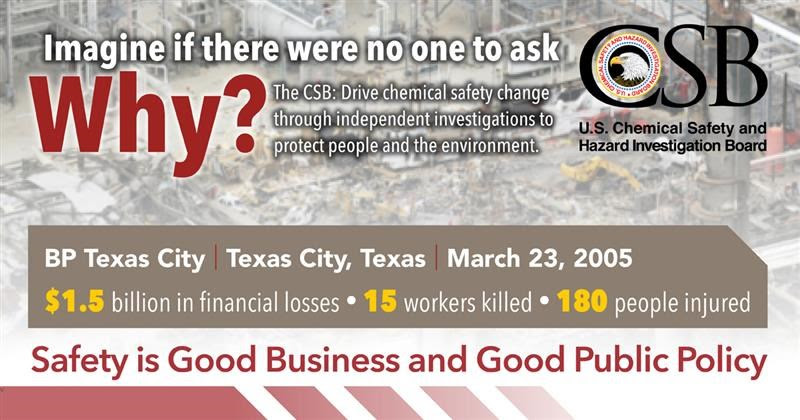 ss and ultimately a company’s bottom line.
Included in the business case are the costs associated with the 2005 explosion and fire at BP Texas City, the 2010 explosion and fire aboard the Macondo/Deepwater Horizon oil rig, the 2012 explosion and fire at the Chevron Refinery and the 2013 fire and massive explosion at West Fertilizer. Each of the four CSB accident investigation details both human and financial tolls which these incidents had on the company and the surrounding communities.
The CSB’s “Business Case for Safety” emphasizes that based on its more than 130 incidents it is clear that hundreds of billions of dollars have been spent as a result of chemical disasters in the United States. To ensure the safety of all Americans it is critical that chemical safety lesson are learned and shared among
diverse stakeholders and across industries to prevent accidents.
Chairperson Sutherland said, “If the CSB’s many safety lessons prevented at least one catastrophic incident, the money saved by preventing damage to the facility and surrounding community, avoiding legal settlements, and saving human lives far exceeds the agency’s $11 million annual budget.”
The CSB concludes that strong safety programs are critical for the economic success of the chemical and petrochemical industries. The CSB’s continued collaboration with industry, regulators, standards setting bodies and other professional organizations proves that the CSB has a vital role in driving critical chemical safety change in the United States.
ss and ultimately a company’s bottom line.Included in the business case are the costs associated with the 2005 explosion and fire at BP Texas City, the 2010 explosion and fire aboard the Macondo/Deepwater Horizon oil rig, the 2012 explosion and fire at the Chevron Refinery and the 2013 fire and massive explosion at West Fertilizer. Each of the four CSB accident investigation details both human and financial tolls which these incidents had on the company and the surrounding communities.
The CSB’s “Business Case for Safety” emphasizes that based on its more than 130 incidents it is clear that hundreds of billions of dollars have been spent as a result of chemical disasters in the United States. To ensure the safety of all Americans it is critical that chemical safety lesson are learned and shared among
diverse stakeholders and across industries to prevent accidents.
Chairperson Sutherland said, “If the CSB’s many safety lessons prevented at least one catastrophic incident, the money saved by preventing damage to the facility and surrounding community, avoiding legal settlements, and saving human lives far exceeds the agency’s $11 million annual budget.”
The CSB concludes that strong safety programs are critical for the economic success of the chemical and petrochemical industries. The CSB’s continued collaboration with industry, regulators, standards setting bodies and other professional organizations proves that the CSB has a vital role in driving critical chemical safety change in the United States.
Monday, April 14, 2014
HAZOP training
April 14, 2014- For those of you who wish to know and
understand more about HAZOP (Hazard and Operability Study)
and associated stuff, there are basically three ways to do it. Here is a list of them with their associated advantages and disadvantages:
a) Surf the web- just like you likely found this page while searching for terms like HAZOP or HAZOP Study free pdf.There will be hundreds or even thousands of articles that range from the fairly easy to understand to the completely complex ones which may leave you gasping for breath (or bored enough to go to sleep). Also the variety and scope will be mind boggling. You will learn all the jargon though...to impress your friends who have no idea about HAZOP studies.
b) Read a book. There are a few about Risk Assessment and HAZOP. None of them covers everything though, so you will have to buy at least three of them to learn anything of value. Of course even if you read them and understand the concepts, you will have nothing in your hand that proves to the world that you know your stuff!
c) Download the HAZOP e-learning course from Abhisam, that covers everything about HAZOP in one, short, easy to understand course. There are several animations and simulations that explain key concepts and make this difficult to understand subject very easy to learn. Besides you can take their online exam and get a Certificate of Competency too, on passing!
Sunday, February 23, 2014
Human Factors in HAZOP & other risk assessment techniques
How important are human factors when carrying out risk assessment studies such as HAZOP, LOPA and other techniques? Very much important it turns out, although until now most practitioners did not include this factor in their risk assessment studies. But of course we know that accidents can and do happen due to human error. Is there a policy guideline for this in place? Yes, it turns out that there is, in fact it was released a long time ago.
The UK Health and Safety Executive reportedly is mulling to include a "human" factor in risk assessment of major hazard facilities (COMAH). They have released a policy roadmap that details this here.
For example if the Risk assessmnet of a major hazard facility shows that it is essential to carry out some maintenance tasks regularly to reduce the risks, then a human factors analysis should be done to find out if
a) whether the task itself could be skipped?
b) whether any alarms can be raised if this is skipped due to error, negligence or simply laziness?
c) whether an incompetent performance of this task could result in an accident?
Very valid questions and a long way to go to analyze all the myriad things that humans can and many times actually do wrong!
So in your next HAZOP review one of the deviations should be "operator did not perform the task at all OR he did not perform the task correctly". This condition has not been included in any HAZOP formats or software to the best of our knowledge but should be and will, in the near future.
If you would like to know more about this aspect, you can check out the Abhisam course here.
Sunday, September 29, 2013
Risk Assessment techniques in the Process Industry
Risk Assessment is defined as the qualitative or quantitative determination of the degree of hazard (or threat) posed by a system, process, or any other entity. While risk assessment is a generic term which may apply to almost anything like the risk of an individual dying immediately after being insured to the probability of a car meeting with an accident while going on a highway, it means different things in the process industry. In the process industry, which can mean a wide variety of industrial sectors right from oil and gas, chemical processing to mining, risk assessment is the quantification or subjective assessment of the degree of hazards that could turn into accidents such as explosions, fire, leakages & spills and so on.
As you can imagine there are several different ways and methods of risk assessment in these industries and there are both quantitative as well as qualitative methods. Quantitative methods of risk assessments are known as QRA or Quantitative Risk Analysis. The subjective ways are many and they comprise of techniques such as HAZOP, HAZID, what if analysis and LOPA (which is also known as semi quantitative). Thus HAZOP is a kind of subjective risk assessment technique used mainly in the process industry (although reportedly some variants are also used in the software and allied sectors).
Among all these techniques, the most popular one today is HAZOP.
 For example, consider the gas storage tanks (spheres) above. There is obviously a risk associated with this storage which is the risk of explosion and or fire or gas leak. Now to assess this risk we can use a variety of risk assessment techniques, the main one being HAZOP. We will break down the unit into logical nodes and each node will then be analyzed using the HAZOP technique to provide an estimate of the risk associated with the storage.
As you can imagine there are several different ways and methods of risk assessment in these industries and there are both quantitative as well as qualitative methods. Quantitative methods of risk assessments are known as QRA or Quantitative Risk Analysis. The subjective ways are many and they comprise of techniques such as HAZOP, HAZID, what if analysis and LOPA (which is also known as semi quantitative). Thus HAZOP is a kind of subjective risk assessment technique used mainly in the process industry (although reportedly some variants are also used in the software and allied sectors).
Among all these techniques, the most popular one today is HAZOP.

Tuesday, September 24, 2013
PHA-Process Hazard Analysis
Today, we will examine in brief what is referred to in industry parlance as PHA or Process Hazard Analysis. PHA refers to any technique that is used to identify hazards that may exist in any industrial, manufacturing or any such similar activity. More specifically it refers to the hazards that are to be identified in the process industry. As you know the "process industry" is a generic term that covers a wide range of industries such as chemicals, oil and gas, power generation, mining and the like. These industries have several hazards present due to the nature of their operations and they need to be identified, reduced to a safe enough level to minimize the risk of accidents and thus mitigate them.
PHA thus refers to any technique that can reliably do so. There are several PHA techniques that are used in the process industry and they are HAZOP (Hazard and Operability Study), What-if analysis, HAZID, LOPA (Layer of Protection analysis) to name a few. Out of these HAZOP and LOPA are growing in popularity worldwide.LOPA as a PHA technique is also used as a SIL determination technique. SIL is an acronym for Safety Integrity Level and we will cover that in a separate post.
Thursday, September 19, 2013
HAZOP-Hazard and Operability Study
Sep 19, 2013- HAZOP is an acronym for the popular Hazard and Operability Study. However the focus of most HAZOP studies seems to be more on the "Hazard" part rather than the "Operability" part. Did you notice it? The operability refers to how easy or how difficult would it be to operate the plant in its current form. For example, it is easy to say (and record) that in case of an upset the plant operator will close the Hand Valve HV101. However where is it located? Is it easy to close it? Is it accessible? What if it requires an effort just to reach it? Would the handle get jammed? These operability questions are very relevant in HAZOP studies and must be addressed.
In recent years, almost nothing is discussed in HAZOP studies about the plant's operability. On hopes that in the coming years the operability factors will also play an important role. After all, a plant that is easy to operate and run should cause less stress amongst operating staff and thereby cause lesser dangerous incidents or accidents, is it not?
One good move in recent years has been though that "human factors" are seen to be as important as the plant design factors and these would be given weightage in the new HAZOP studies.
For an in-depth course on the Hazard and Operability technique, you can refer to the Abhisam training course on HAZOP.
Friday, August 9, 2013
HAZOP
Aug 9, 2013- HAZOP stands for Hazard and Operability Study. This acronym, HAZOP is used extensively to describe the HAZOP Study technique that is a very popular risk assessment technique in industries such as Oil and Gas, Chemical, Power, Mining and others, where there may be several hazards that need to be identified and risks mitigated. The following HAZOP YouTube video by Abhisam is useful to get an overview of the technique and how to learn more about it.
Of course, HAZOP is not the only Risk Assessment technique around, there are others such as Hazard Matrix, HAZAN and HAZID too. However over the years HAZOP has proved to be much more popular than any of the other techniques.
Of course, HAZOP is not the only Risk Assessment technique around, there are others such as Hazard Matrix, HAZAN and HAZID too. However over the years HAZOP has proved to be much more popular than any of the other techniques.
Tuesday, July 16, 2013
HAZOP Video-Training Course
Here's a great video about HAZOP training that is on Youtube. See it below for yourself. The video basically tells you about HAZOP and how you can learn it in the comfort of your own home or office. Attending classroom trainings can be a pain these days, as you will have to spare time as well as a great deal of money AND be away from work to attend it. At the end of the day you may forget everything!
So here's an alternate way to learn all about the HAZOP process and also get certified in HAZOP! Note that it is not just a HAZOP ppt, it is a complete course.
Thursday, April 25, 2013
HAZOP Study
HAZOP Study- What is HAZOP?
(Note: To learn about HAZOP Study in detail and to get certified as a competent person, please download or enroll online in the Abhisam HAZOP training course)
HAZOP is an acronym which is short for Hazard and Operability study and it was first introduced many years ago by ICI, a multinational chemicals company, based out of the UK. ICI no longer exists today as ICI (various parts have been taken over by companies such as Huntsman and AkzoNobel), but the HAZOP study technique that they pioneered, continues to grow in importance.
HAZOP is a risk assessment technique, used mainly in the chemical and process industries such as oil and gas, refining, petrochemical, heavy chemicals, pharmaceutical and power generation as well as industries such as mining too. HAZOP is one technique out of a group of risk assessment techniques that form part of PHA (Process Hazard Analysis) . Other techniques in PHA are FMEA (Failure Modes and Effects Analysis), LOPA (Layer of Protection Analysis), HAZID (Hazard Identification), What-If analysis and of course checklists. HAZOP is more subjective rather than quantitative.
The HAZOP technique is designed to identify the intentions and deviations of a particular operation, called a node. For example, a node may be a section of a plant that pumps liquid from a storage tank to a reactor some distance away. Then in this node, the original intention is identified (transporting liquid from the storage tank to the reactor) and then all possible deviations are analyzed in detail. Some of these deviations may result in accidents (for example if there is a reverse flow of liquid from the reactor to the tank). This process (the HAZOP process) is known as a HAZOP Study.
You may now appreciate that a HAZOP study should be done only by skilled personnel. If an unskilled or untrained person carries out a HAZOP (using the best software or no software), the chances of doing a bad HAZOP increase manifold. Doing a bad HAZOP is worse than doing no HAZOP at all because a bad HAZOP lulls people into a false sense of security, that their HAZOP study is complete (and the recommendations are implemented and the plant is safe and everybody lived happily ever after) when actually the opposite is true.
HAZOP Process
HAZOP Process-what does it mean? The word HAZOP is an acronym for HAZard and Operability Study, which is a Risk Assessment technique used extensively in the process industries (such as Oil and Gas, Chemicals, Petrochemicals, Power, Pharma and others). The HAZOP Process is a structured method that is a part of a PHA (Process Hazard Analysis), in which one examines a small part of a plant or facility (called as a Node) using a set of Guide Words that seek to examine all the permutations and combinations possible in a particular plant operation. For example, if one is analyzing the flow of a liquid from say a day tank (lets call it Tank A) to another tank (say Tank B) then there are several things that can go wrong with this simple process, such as Low Flow, Reverse Flow, No Flow and so on. These guide words (Low, Reverse, No) are combined with a parameter (such as Flow) to generate possibilities of what could go wrong in the operation.
Then each combination gives us an opportunity to think what can happen. For example if the normal operation of the process is to transfer liquid from Tank A to Tank B, then Reverse Flow will be from Tank B to Tank A. Will this cause any problems? We then list all these problems under the heading of "consequences" and for each consequence we can think of a protective method by which this consequence can be avoided. Thus if we determine that reverse flow will have dangerous consequences, then we can prevent it by having a Non Return Valve in the line that connects Tank A to Tank B.
Thus each such condition will be evaluated for consequences and protective measures designed. If we do this diligently for the entire plant, we will have a much safer operation!
If you wish to know more about this HAZOP Process, you can download an excellent e-learning course here.
Subscribe to:
Posts (Atom)