Showing posts with label plant operator. Show all posts

Tuesday, April 25, 2017

US Chemical Board publishes Business Case for Safety

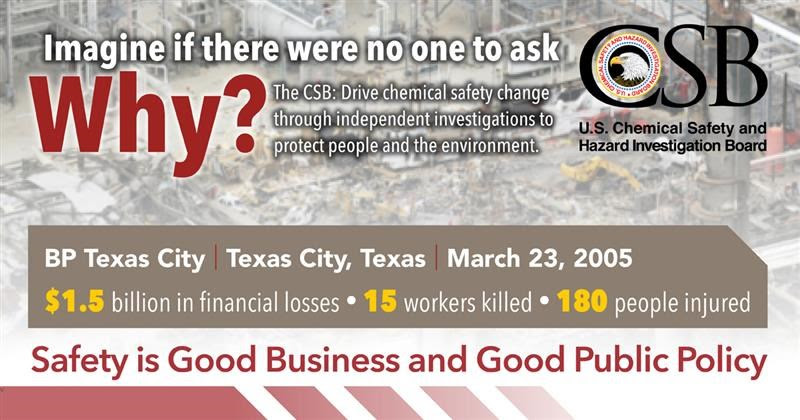
April 14, 2017, Washington, D.C.  - Today the CSB released a “Business Case for Safety” that summarizes four major accident investigations. The six page documents details how safety is good for busineCSB_Infographic_BP_TCss and ultimately a company’s bottom line.

Included in the business case are the costs associated with the 2005 explosion and fire at BP Texas City, the 2010 explosion and fire aboard the Macondo/Deepwater Horizon oil rig, the 2012 explosion and fire at the Chevron Refinery and the 2013 fire and massive explosion at West Fertilizer. Each of the four CSB accident investigation details both human and financial tolls which these incidents had on the company and the surrounding communities.

The CSB’s “Business Case for Safety” emphasizes that based on its more than 130 incidents it is clear that hundreds of billions of dollars have been spent as a result of chemical disasters in the United States. To ensure the safety of all Americans it is critical that chemical safety lesson are learned and shared among CSB_Infographic_WFC

diverse stakeholders and across industries to prevent accidents.

Chairperson Sutherland said, “If the CSB’s many safety lessons prevented at least one catastrophic incident, the money saved by preventing damage to the facility and surrounding community, avoiding legal settlements, and saving human lives far exceeds the agency’s $11 million annual budget.”

The CSB concludes that strong safety programs are critical for the economic success of the chemical and petrochemical industries. The CSB’s continued collaboration with industry, regulators, standards setting bodies and other professional organizations proves that the CSB has a vital role in driving critical chemical safety change in the United States.
 

Sunday, February 23, 2014

Human Factors in HAZOP & other risk assessment techniques

How important are human factors when carrying out risk assessment studies such as HAZOP, LOPA and other techniques? Very much important it turns out, although until now most practitioners did not include this factor in their risk assessment studies. But of course we know that accidents can and do happen due to human error. Is there a policy guideline for this in place? Yes, it turns out that there is, in fact it was released a long time ago.
The UK Health and Safety Executive reportedly is mulling to include a "human" factor in risk assessment of major hazard facilities (COMAH). They have released a policy roadmap that details this here.
For example if the Risk assessmnet of a major hazard facility shows that it is essential to carry out some maintenance tasks regularly to reduce the risks, then a human factors analysis should be done to find out if
a) whether the task itself could be skipped?
b) whether any alarms can be raised if this is skipped due to error, negligence or simply laziness?
c) whether an incompetent performance of this task could result in an accident?
Very valid questions and a long way to go to analyze all the myriad things that humans can and many times actually do wrong!
So in your next HAZOP review one of the deviations should be "operator did not perform the task at all OR he did not perform the task correctly". This condition has not been included in any HAZOP formats or software to the best of our knowledge but should be and will, in the near future.
If you would like to know more about this aspect, you can check out the Abhisam course here.

Thursday, September 19, 2013

HAZOP-Hazard and Operability Study

Sep 19, 2013- HAZOP is an acronym for the popular Hazard and Operability Study. However the focus of most HAZOP studies seems to be more on the "Hazard" part rather than the "Operability" part. Did you notice it? The operability refers to how easy or how difficult would it be to operate the plant in its current form. For example, it is easy to say (and record) that in case of an upset the plant operator will close the Hand Valve HV101. However where is it located? Is it easy to close it? Is it accessible? What if it requires an effort just to reach it? Would the handle get jammed? These operability questions are very relevant in HAZOP studies and must be addressed. In recent years, almost nothing is discussed in HAZOP studies about the plant's operability. On hopes that in the coming years the operability factors will also play an important role. After all, a plant that is easy to operate and run should cause less stress amongst operating staff and thereby cause lesser dangerous incidents or accidents, is it not? One good move in recent years has been though that "human factors" are seen to be as important as the plant design factors and these would be given weightage in the new HAZOP studies. For an in-depth course on the Hazard and Operability technique, you can refer to the Abhisam training course on HAZOP.