HAZOP Guide words are one of the unique things about the Hazard and Operability technique. There are a set of commonly used words that can be used to generate multiple abnormal scenarios, which we call as "deviations" in the technique. Every such word coupled with a particular parameter, then represents a unique deviation. For example to study a deviation of a flow lesser than normal, we use the guideword less or lesser than, coupled with a parameter flow. These two combined give us the deviated scenario of less than normal flow.
This less than normal flow is then analyzed thoroghly by the HAZOP team members to brainstorm if it will lead to nay dangerous consequences. If such is indeed the case, then the team's scribe (also known as HAZOP Scribe) writes down this as a dangerous consequence in the worksheet. Generally if the plant's design is sufficiently robust, then such deviated conditions are taken care of by the basic process design such as for example, having a flow switch that trips the pumping if the flow is low (just an example). If not, then the team suggests this, which goes into the worksheet as a recommendation. There may be of course other ways in which these parameters can be recognized and safeguards built, to correct for the effects of such abnormal conditions happening.
But then we are deviating from the topic- we are here to learn about guide words, right? You may be wondering how can somebody think of all the guidewords that are needed? Well, you can simply write down all of them at the beginning itself, or enter them into your HAZOP Worksheet before you begin the study. If you are using a documenting HAZOP Software, then the guidewords are already in the database and will be used to generate the different scenario conditions.
What are some common examples of such guide words? Here is a snippet of such a list below:
LESS
MORE
OTHER THAN
REVERSE
NO
EARLY
LATE
Now if you couple them with a parameter such as FLOW, you get the deviations as below:
LESS FLOW
MORE FLOW
OTHER THAN FLOW (checks if the fluid has been substituted by another one)
REVERSE FLOW (direction of flow has changed)
NO FLOW (empty)
The below ones can be used for batch processes, where sequencing is of importance.
EARLY FLOW (fluid starts flowing earlier than what is designed)
LATE FLOW (starts flowing later than designed).
If you need a more comprehensive training in this technique, then simply go to the HAZOP training course here. You can get access to an excellent e-learning course and what's more, also earn a certificate and an electronic badge, if you pass the associated exam.
Showing posts with label risk analysis. Show all posts
Showing posts with label risk analysis. Show all posts
Thursday, May 2, 2019
Tuesday, April 25, 2017
US Chemical Board publishes Business Case for Safety
April 14, 2017, Washington, D.C. - Today the CSB released a “Business Case for Safety” that summarizes four major accident investigations. The six page documents details how safety is good for busine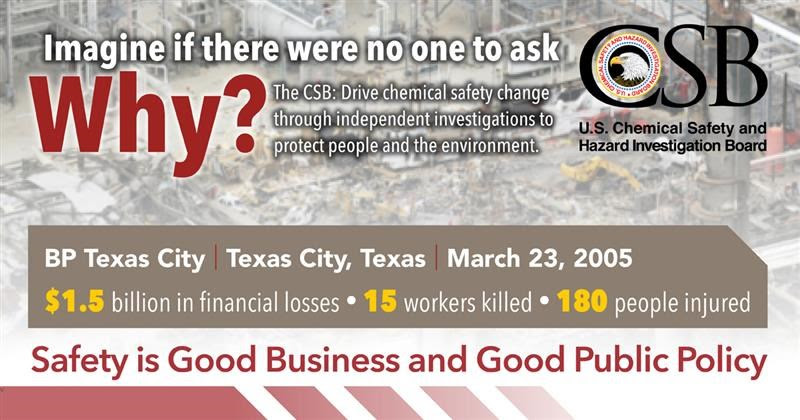 ss and ultimately a company’s bottom line.
Included in the business case are the costs associated with the 2005 explosion and fire at BP Texas City, the 2010 explosion and fire aboard the Macondo/Deepwater Horizon oil rig, the 2012 explosion and fire at the Chevron Refinery and the 2013 fire and massive explosion at West Fertilizer. Each of the four CSB accident investigation details both human and financial tolls which these incidents had on the company and the surrounding communities.
The CSB’s “Business Case for Safety” emphasizes that based on its more than 130 incidents it is clear that hundreds of billions of dollars have been spent as a result of chemical disasters in the United States. To ensure the safety of all Americans it is critical that chemical safety lesson are learned and shared among
diverse stakeholders and across industries to prevent accidents.
Chairperson Sutherland said, “If the CSB’s many safety lessons prevented at least one catastrophic incident, the money saved by preventing damage to the facility and surrounding community, avoiding legal settlements, and saving human lives far exceeds the agency’s $11 million annual budget.”
The CSB concludes that strong safety programs are critical for the economic success of the chemical and petrochemical industries. The CSB’s continued collaboration with industry, regulators, standards setting bodies and other professional organizations proves that the CSB has a vital role in driving critical chemical safety change in the United States.
ss and ultimately a company’s bottom line.Included in the business case are the costs associated with the 2005 explosion and fire at BP Texas City, the 2010 explosion and fire aboard the Macondo/Deepwater Horizon oil rig, the 2012 explosion and fire at the Chevron Refinery and the 2013 fire and massive explosion at West Fertilizer. Each of the four CSB accident investigation details both human and financial tolls which these incidents had on the company and the surrounding communities.
The CSB’s “Business Case for Safety” emphasizes that based on its more than 130 incidents it is clear that hundreds of billions of dollars have been spent as a result of chemical disasters in the United States. To ensure the safety of all Americans it is critical that chemical safety lesson are learned and shared among
diverse stakeholders and across industries to prevent accidents.
Chairperson Sutherland said, “If the CSB’s many safety lessons prevented at least one catastrophic incident, the money saved by preventing damage to the facility and surrounding community, avoiding legal settlements, and saving human lives far exceeds the agency’s $11 million annual budget.”
The CSB concludes that strong safety programs are critical for the economic success of the chemical and petrochemical industries. The CSB’s continued collaboration with industry, regulators, standards setting bodies and other professional organizations proves that the CSB has a vital role in driving critical chemical safety change in the United States.

Sunday, September 29, 2013
Risk Assessment techniques in the Process Industry
Risk Assessment is defined as the qualitative or quantitative determination of the degree of hazard (or threat) posed by a system, process, or any other entity. While risk assessment is a generic term which may apply to almost anything like the risk of an individual dying immediately after being insured to the probability of a car meeting with an accident while going on a highway, it means different things in the process industry. In the process industry, which can mean a wide variety of industrial sectors right from oil and gas, chemical processing to mining, risk assessment is the quantification or subjective assessment of the degree of hazards that could turn into accidents such as explosions, fire, leakages & spills and so on.
As you can imagine there are several different ways and methods of risk assessment in these industries and there are both quantitative as well as qualitative methods. Quantitative methods of risk assessments are known as QRA or Quantitative Risk Analysis. The subjective ways are many and they comprise of techniques such as HAZOP, HAZID, what if analysis and LOPA (which is also known as semi quantitative). Thus HAZOP is a kind of subjective risk assessment technique used mainly in the process industry (although reportedly some variants are also used in the software and allied sectors).
Among all these techniques, the most popular one today is HAZOP.
 For example, consider the gas storage tanks (spheres) above. There is obviously a risk associated with this storage which is the risk of explosion and or fire or gas leak. Now to assess this risk we can use a variety of risk assessment techniques, the main one being HAZOP. We will break down the unit into logical nodes and each node will then be analyzed using the HAZOP technique to provide an estimate of the risk associated with the storage.
As you can imagine there are several different ways and methods of risk assessment in these industries and there are both quantitative as well as qualitative methods. Quantitative methods of risk assessments are known as QRA or Quantitative Risk Analysis. The subjective ways are many and they comprise of techniques such as HAZOP, HAZID, what if analysis and LOPA (which is also known as semi quantitative). Thus HAZOP is a kind of subjective risk assessment technique used mainly in the process industry (although reportedly some variants are also used in the software and allied sectors).
Among all these techniques, the most popular one today is HAZOP.

Subscribe to:
Posts (Atom)